


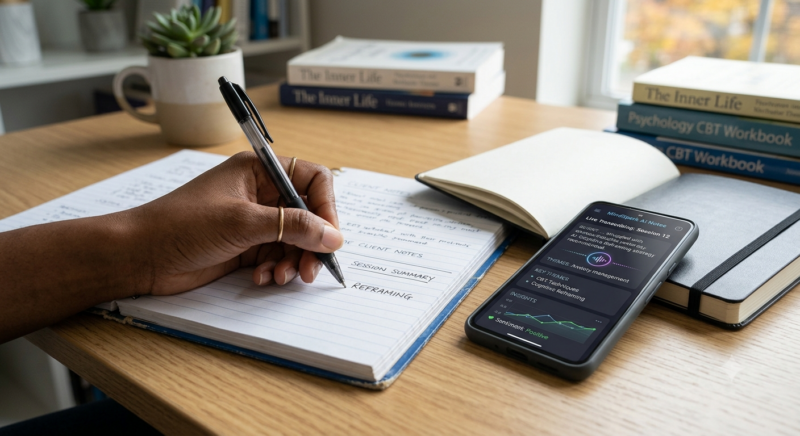
If you've been to therapy recently, there's a good chance your session was recorded, not by your therapist's memory, but by an AI tool sitting quietly in the background, so the therapist doesn't have to spend their evening writing notes. Should that worry you? Or is it actually making your care better?
We’ve heard about people using AI chatbots as their ‘therapist’, but do therapists use AI too? The better question is how. The answer is mostly administrative. Therapists use AI scribes to record and transcribe sessions, then draft a clinical note for review afterward. One therapist described the shift bluntly: work that used to take her 15 to 20 minutes per client now takes about two minutes. Multiply that across a caseload, and it adds up. Most therapists spend 5 to 7 hours a week just on documentation. That’s time now being handed back to actually being present with patients, instead of catching up on paperwork after hours. Of course, the tool isn’t perfect, therapists still have to review every AI-generated note carefully, since even small errors can end up permanently in a patient’s record.

But is the role of AI just limited to paperwork? We know it’s capable of more than that. Modern AI tools are now being used by therapists to fill in the gaps, noticing things a therapist might miss entirely. Wearable devices like an Apple Watch can provide data such as sleep patterns, step count, or even how much time someone spends at home. This data can then be used by therapists to surface insights they can bring into a session. In one study, ChatGPT was given a patient’s sleep, activity, and location data and asked to highlight anything clinically relevant. Interestingly, the therapists involved didn’t want to use this to jump to a diagnosis. Instead, they wanted to explore the patterns together with the patient. For example, someone struggling with anxiety might discover that their insomnia and anxiety symptoms spike specifically on days they never left the house, opening up a real conversation about avoidance as a coping habit. It’s a small change with a big impact: therapists are no longer limited to only what a patient remembers to mention in session. There’s an entire layer of everyday data that can now help tell the fuller story.
So why can’t AI simply replace a therapist? There have been numerous instances where people actually seek psychological help from AI, but it is not that simple. Part of it comes down to the relationship between a therapist and a client. Decades of psychological research show that one of the strongest predictors of successful therapy isn’t the specific technique used, it’s the quality of the relationship itself, often called the therapeutic alliance. That kind of trust builds over time, through a real human who remembers your history, notices patterns across sessions, and can pick up on things left unsaid. AI can offer comfort in the moment, but it doesn’t build that same continuous, evolving understanding of who you are. There’s also the matter of accountability: a licensed therapist is trained to recognize warning signs, like suicidal ideation and is professionally and ethically responsible for acting on them. AI carries no such responsibility, and as discussed earlier, its tendency to agree rather than challenge means it may not push back when someone actually needs to hear a harder truth. AI can be a helpful companion in someone’s mental health journey. But companionship isn’t the same as care with accountability behind it.
Even when a licensed therapist uses AI the right way, it still isn’t perfect. One therapist using an AI note-taking tool said it sometimes makes things up, so she has to carefully check every note before it becomes official. This matters a lot here. If a mistake ends up in a patient’s official record, it can stay there and cause problems later. This is also why professional rules require therapists to be upfront about using AI. Clients have a right to know, to agree to it, and to say no if they’re not comfortable. Not every AI tool is even allowed to handle patient information in the first place, regular chatbots usually can’t be used with real health data unless there’s a special privacy agreement in place. In short, AI in therapy comes with real rules and limits, it supports the therapist, it doesn’t replace their judgment

So, do therapists use AI? Yes, but not in the way most people imagine. It’s not replacing therapists; it’s supporting them. From writing notes faster to spotting patterns in a patient’s daily life, AI is helping clinicians spend more time actually caring for people and less time on paperwork. But it comes with real limits, mistakes happen, privacy rules matter, and no AI tool can replace the trust and understanding built between a therapist and a client over time. AI might be a helpful assistant in the therapy room, but the therapist is still the one doing the caring.
Blog by: Tarunpreet Singh

